
Learn piano
Piano for kids – tips for parents
Your child wants to play the piano? Wonderful. Here you’ll find out at what age it usually works well, how much practice makes sense, how to support your child without pressure, and what matters when choosing an instrument.
- Free to start
- Short sessions
- Digital piano or on-screen keys
- Parents practise along
Updated
What age should kids start?
Many children start between five and seven. At that age, focus and finger strength are usually enough to practise for a few minutes at a time and to read their first notes. Younger children can explore the keys playfully, play along to songs and clap rhythms.
Curiosity matters more than the exact age. A child who wants to sit at the piano on their own is ready for the next step.
How much should a child practise?
Five to fifteen minutes a day is plenty at the start. Short and regular beats long and rare: children remember far more when they play a little every day. Stopping on a success makes them happy to come back tomorrow.
How parents can help
You don’t need to play the piano yourself to support your child well:
- Find a fixed practice time, for example after dinner. Habit beats motivation.
- Sit with them and listen, especially at the beginning. “Will you play that for me?” works better than reminders.
- Praise progress, not just mistake-free playing.
- Choose songs your child knows and likes.
- Set small goals: one song this week, not a whole book.
- Allow breaks. A day without practice is not a step back.
Reading music from the start
Children learn notes most easily in small portions: a few notes, lots of repetition, straight away at the instrument. Kids who read music early can later work out any piece on their own. Mnemonics, game ideas and free worksheets are on the page “Music notes for kids”, linked below.
Lessons, an app or both?
A teacher gives the most personal feedback, including on posture and sound. Between lessons, an app that listens helps: your child sees straight away whether a note was right and doesn’t practise mistakes for weeks. Many families combine both.
Which instrument?
On-screen keys or a simple keyboard are enough to try it out. In the long run a digital piano with 88 weighted keys is worth it: fingers learn the right touch, and with headphones practice doesn’t disturb anyone. Check the seat height: forearms should be roughly level with the keys, using a cushion or a footstool if needed.
Using Notimo with kids
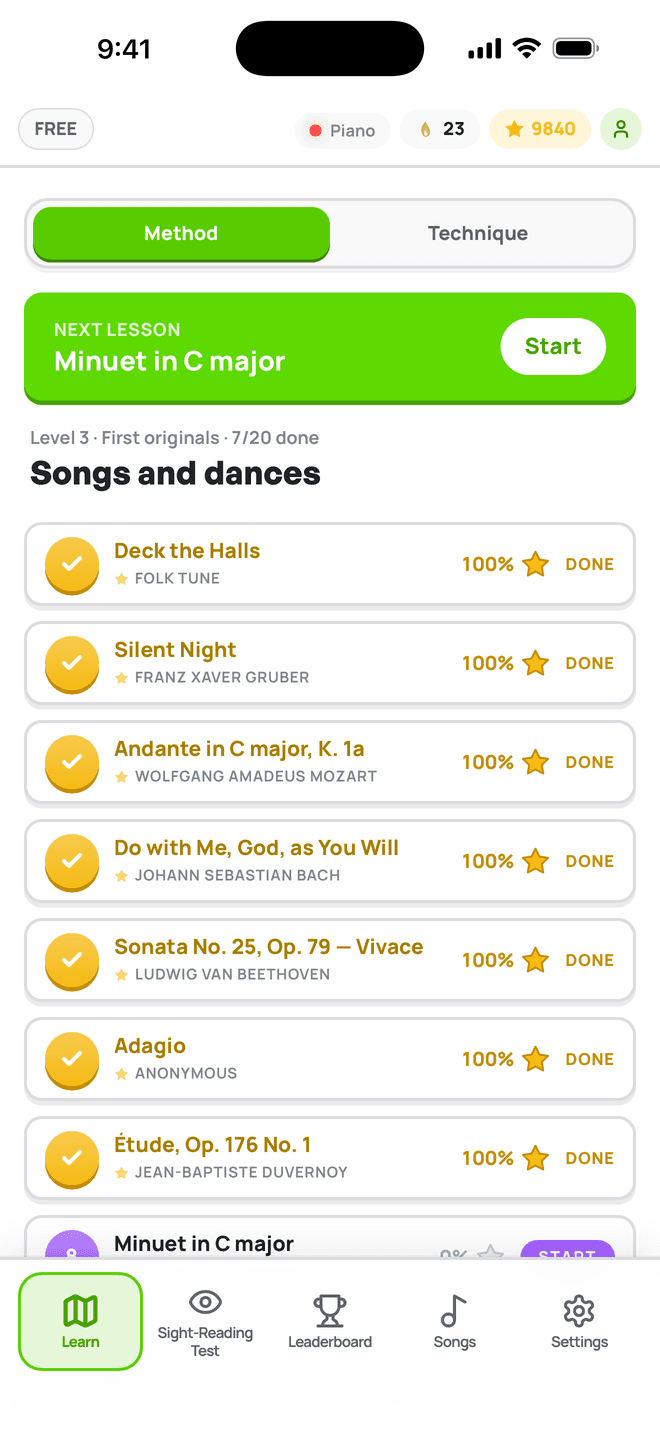
Notimo shows real sheet music, listens to what is played and gives instant feedback on every note. Lessons take about five minutes, which suits a child’s attention span well.
A Notimo account requires age 16. For children, a parent creates the account and you practise together. That way you also keep an eye on screen time. Tip: turn off “Visible to others” in the settings so practice progress does not appear on the leaderboard or in the league.
Frequently asked questions
What is the best age to start piano?
Many children start between five and seven. Younger children can explore the keys playfully. What matters most is that your child wants to.
How long should my child practise each day?
Five to fifteen minutes a day at the start. Regularity matters more than length.
Do we need a piano right away?
No. On-screen keys or a keyboard are enough to try it out. If your child sticks with it, a digital piano with weighted keys is worth it.
Do I need to play the piano myself?
No. Sitting with your child, listening and praising helps more than your own skills.
Can my child use Notimo alone?
A Notimo account requires age 16. For children, a parent creates the account and you practise together.
Start together. Five minutes is enough.
Free to start, no credit card. With a digital piano, keyboard or on-screen keys.