
Learn piano
How to learn piano – start the right way
Want to learn piano but not sure where to begin? Here you’ll find the main ways to learn compared, a plan for your first four weeks, ten practical tips and honest answers to the questions beginners ask most – whatever your age.
- Free to start
- No credit card
- Browser, iPhone, iPad & Android
- Digital piano or on-screen keys
Updated
Try it
Learn piano without a piano
Start on the on-screen keys: read the note and tap the matching key. That is exactly how the first lesson feels.
Four ways to learn piano
There is no single right way. The four most common ones differ mainly in how much feedback you get, what they cost and whether you can read music at the end.
- Lessons with a teacher: the most personal feedback, including posture and tone. In return, fixed appointments and usually the highest cost.
- Teach yourself with sheet music – from a book or an app: you learn to read music and can work out any piece on your own afterwards. An app with feedback tells you instantly whether each note was right.
- Online courses and videos: plenty of choice and flexible. But a video can’t hear you – you only notice mistakes yourself.
- By ear or with falling-notes apps: quick first songs. Without reading music, though, many people get stuck with pieces someone has to show them.
Why reading music is worth it
Sheet music is the language almost all piano pieces are written in. Once you can read it, you don’t depend on videos or light-up keys and can learn new pieces on your own – from nursery rhymes to Bach.
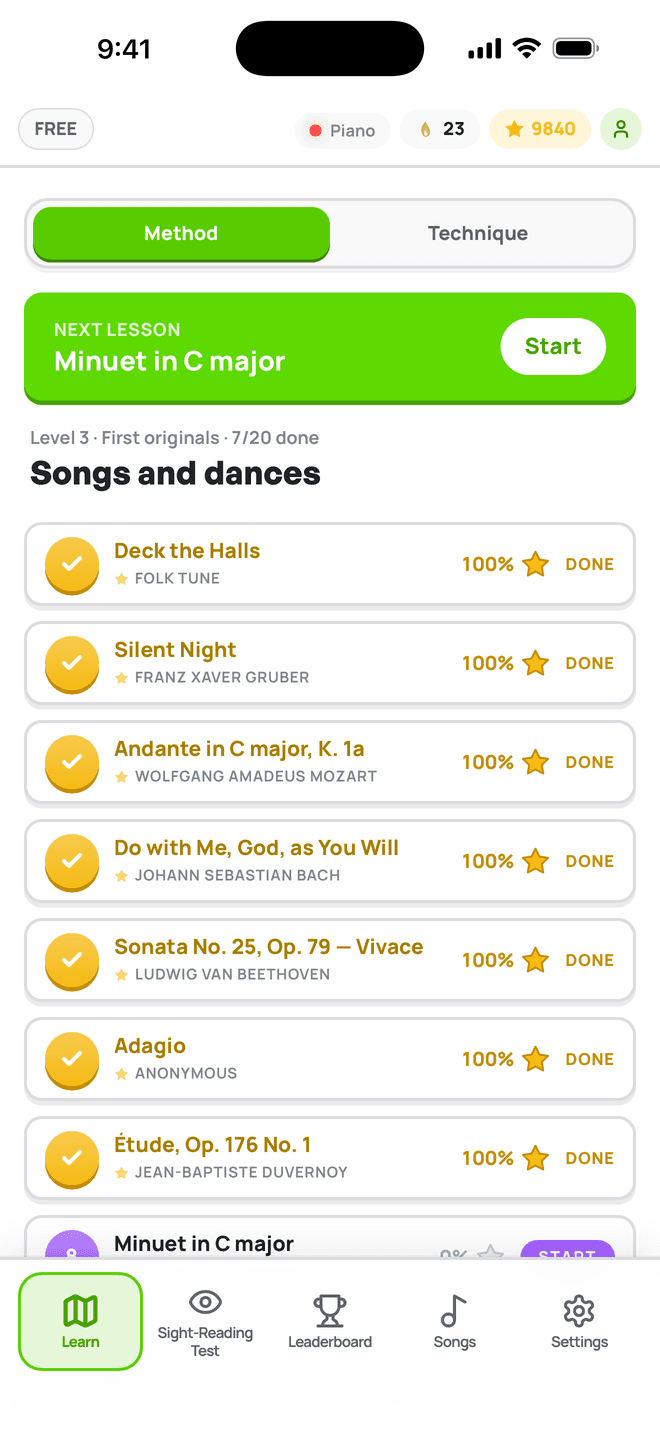
This is where Notimo starts: you see the note on the staff, play the key on your digital piano, MIDI keyboard or the on-screen keys, and know right away whether it was correct. You learn to read and to play at the same time.
Your first four weeks
A simple plan for the start – about ten minutes a day:
- Week 1: Get to know the keyboard, find middle C and read your first notes in the treble clef.
- Week 2: Five notes with the right hand, fingers 1 to 5, your first short melodies.
- Week 3: Simple rhythms – whole, half and quarter notes – and the left hand in the bass clef.
- Week 4: Both hands one after the other, then together. Your first small piece from start to finish.
10 tips for learning piano
These habits help beginners the most:
- Ten minutes every day beats one hour once a week.
- Play slowly. Speed comes by itself – mistakes sink in just as quickly.
- Practise hands separately before putting them together.
- Work on difficult bars on their own instead of always starting from the top.
- Choose a fingering and stick with it.
- Practise with a metronome – slowly at first, then a little faster step by step.
- Read a few notes every day, even without an instrument.
- Pick pieces you love – motivation beats discipline.
- Record yourself now and then and listen back.
- Take breaks: after 20 to 30 minutes your focus noticeably drops.
Learning piano as an adult
It’s never too late. Adults learn differently from children, but not worse: they understand connections faster, practise more deliberately and know why they want to play. What’s usually missing is time – and short, regular sessions are enough.
Many adults now learn without a teacher, at their own pace. What matters then is feedback that shows you what’s solid and what’s still shaky.
Learning piano with children
Many children start between five and seven. Short sessions, songs they know and a small success every day keep them going. For reading music there are dedicated worksheets and game ideas – linked below.
How much to practise – and how long does it take?
Ten to twenty minutes a day is a good guide for beginners. With that, most people play their first simple pieces with both hands after a few weeks. Reading notes without counting lines takes months rather than weeks – that’s normal.
Regularity matters more than duration. Five minutes on a busy day is better than none.
Do I need a piano?
Not to try it: with the on-screen keys you can start right away, just like above on this page. In the long run a digital piano or keyboard is worth it – ideally with 88 weighted keys and a headphone jack. Connected by USB or MIDI, Notimo recognises every key you play.
Frequently asked questions
Can you learn piano without a teacher?
Yes. Many people teach themselves with books, apps or videos. What matters is a clear plan, regular practice and feedback on whether you’re playing correctly. For posture and technique, an occasional lesson with a teacher can still help.
How long does it take to learn piano?
With ten to twenty minutes of daily practice, most beginners play their first simple pieces after a few weeks. Reading music fluently and playing intermediate pieces usually takes one to two years. You’re never really finished – that’s part of it.
Am I too old to learn piano at 40, 50 or 60?
No. You can start at any age. Adults often progress faster than they expect because they practise deliberately and understand how things fit together.
Do I need to read music before I start?
No, you learn to read music from the very beginning. In Notimo each lesson starts with just a few notes, and new ones only come once the old ones are solid.
Is piano hard to learn?
The start is easier than on many other instruments: every key produces a clean note right away. It gets harder when both hands play different things – that takes patience, not special talent.
How much does learning piano with Notimo cost?
You can start for free with a free account and no credit card. The first lessons, the theory course, the sight-reading test, the virtual piano and the metronome are free. The full learning path, the library and all training modes come with Notimo Pro.
Start today. Five minutes is enough.
Free to start, no credit card. With a digital piano, keyboard or on-screen keys.