
Learn piano
How long does it take to learn piano?
The honest answer: you’ll play your first little pieces within a few weeks, reading easy music fluently takes a few months, and intermediate pieces more like one to two years. How fast it goes depends less on your age than on how regularly you practise. Here’s a realistic timeline.
- Free to start
- No credit card
- 10–20 minutes a day
- Digital piano or on-screen keys
Updated
A realistic timeline
These ranges are for beginners who practise 10 to 20 minutes on most days. Practise more and you’ll move faster; skip weeks and it takes longer.
- After 1 to 2 weeks: you can find middle C, know your first notes in the treble clef and play short right-hand melodies.
- After 1 to 3 months: both clefs, simple rhythms and your first pieces with both hands – still slowly, still counting.
- After 6 to 12 months: you read simple pieces without hunting for notes, your hands play different things, and scales with the thumb passing under feel natural.
- After 1 to 2 years: easy to intermediate classical pieces and pop songs, and you can work out new pieces from the sheet music on your own.
- After that: you’re never really done. Even advanced players learn something new with every piece – that’s part of the fun.
How much should you practise a day?
For beginners, 10 to 20 minutes a day is a good guide. Short, regular sessions beat one long hour at the weekend: what you practised today is still fresh tomorrow, and small mistakes don’t become habits.
For many people, concentration drops noticeably after 20 to 30 minutes. If you have more time, split it up – a short session in the morning and one in the evening. And on busy days, five minutes is better than none.
What helps you progress faster
More time isn’t the only lever. These habits turn the same practice time into more progress:
- Learn to read music from the start. Playing by ear or with light-up keys gets you to your first songs quickly, but often leaves you stuck with pieces someone showed you.
- Practise slowly. Speed comes by itself; a wrong note you’ve practised stays for a long time.
- Practise hands separately before putting them together.
- Repeat difficult bars on their own instead of always starting from the top.
- Get feedback: a teacher, or an app that listens, shows you straight away what’s solid and what still wobbles.
- Sight-read a few notes every day – it trains exactly the skill that takes longest at the piano.
Do adults learn more slowly?
Hardly. Children often have more time and fewer inhibitions; adults understand concepts faster and practise more purposefully. For both, regularity matters most. More in the article “Learn piano as an adult”, linked below.
How Notimo uses your time
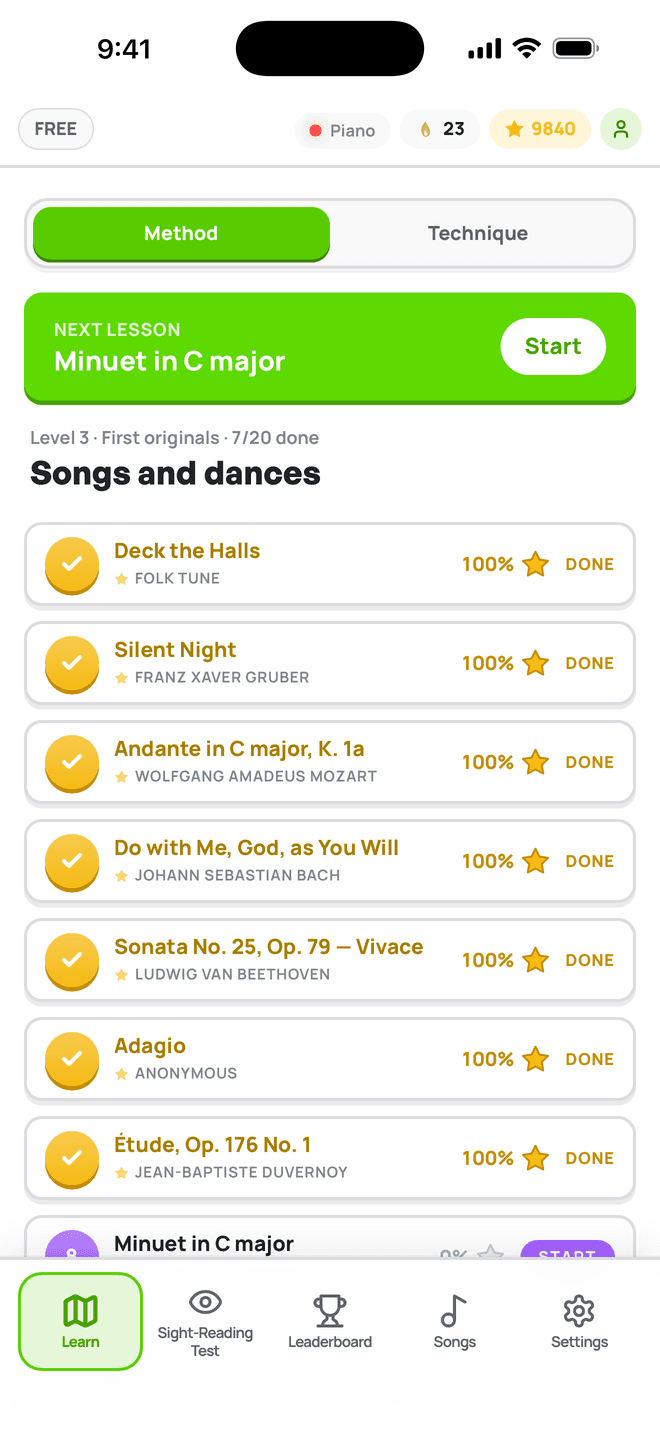
Each lesson takes about five minutes. You see real sheet music, play on your digital piano, MIDI keyboard or the on-screen keys, and every note is checked instantly. New notes only come once the old ones are solid – so ten minutes a day turns into progress you can feel.
Frequently asked questions
Can you learn piano in a year?
With regular practice, most beginners can play simple pieces with both hands and read easy music without hunting for notes after a year. For intermediate pieces, plan on one to two years.
How long does it take to learn to read music?
Most people learn the basics – note names in both clefs and simple rhythms – in a few weeks. Reading fluently without counting lines takes months. Daily sight-reading shortens that a lot.
Is 10 minutes a day enough?
At the start, yes – as long as it’s regular. Ten minutes on six days beats one hour on one day. Later, with longer pieces, 20 to 30 minutes helps.
Am I too old to learn piano?
No. You can start at any age. Adults often progress faster than they expect because they practise purposefully.
How long does a specific piece take, like “Für Elise”?
It depends on the piece and where you are. Many learners can play the famous theme of “Für Elise” after a few months, the whole piece more like after one to two years. Simplified versions come earlier.
Start today. Five minutes is enough.
Free to start, no credit card. With a digital piano, keyboard or on-screen keys.